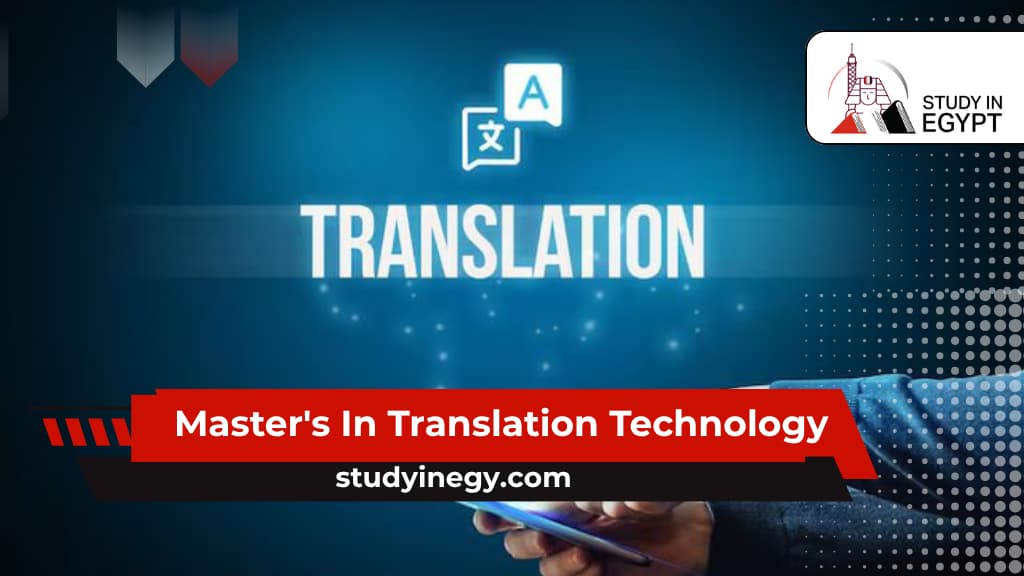
Master’s In Translation Technology — Faculty Of Al-Alsun, Ain Shams University … Artificial intelligence has drawn new and fundamentally radical equations in the work environment of “white-collar” professionals, including, certainly, translation and its specializations.
In light of the implications of these equations, the specialized human translator is no longer in confrontation with the machine—rather, it has become for him an astonishing tool that achieves the equation of integration between the speed of the machine and the accuracy and reliability of specialized translators, and this subtle difference is what determines the path of the specialist in today’s world.
In this context, the demands of a large number of outstanding students seeking to deal intelligently and pragmatically with artificial intelligence and its impacts in the field of translation have emerged, so they study the Translation Technology program.
This is because translation technology is not a specialization that chases change or accepts the stagnation of outdated techniques, but rather it is the specialization that understands the essence of those technologies from within and knows how to employ them to ensure the best possible result. In this context, the Faculty of Al-Alsun at Ain Shams University, with its history extending since 1835, realizes this equation and translates it realistically into academic programs that address and refine what is required at the heart of the labor market, not at its margins.
In this article, we review in detail what every international student needs to know about the Master’s in Translation Technology at the Faculty of Al-Alsun — from the structure of the program and the effectiveness of its curricula to the value of the degree to the cost of tuition and the advantages.
Periodic Adaptation: Dealing With All Changes Realistically And Intelligently
What distinguishes the Translation Technology program at the Faculty of Al-Alsun, Ain Shams University, from traditional translation programs is that it does not deal with technology as an additional subject of study or approach it theoretically, but rather as a fundamental pillar in building the specialist.
The program primarily aims to prepare cadres proficient in using the latest technologies and artificial intelligence systems assisting specialized translation.
It also aims to graduate individuals qualified to enter the field of scientific research in the development of applications related to translation technology so that its students become an essential and indispensable part of this field due to the creative and integrative capabilities it develops in them.
At the practical level, the faculty provides students with skills in using the latest translation software professionally and responsibly with the help of computers and terminology storage programs.
This equips students with real experience that the labor market recognizes and relies on, and what is also important is the high level of accuracy and reliability that the faculty is keen to instill in the students.
This also includes training on CAT Tools such as SDL Trados and MemoQ and the management of Translation Memory and Terminology databases—tools that are not requested by various international translation agencies as a secondary advantage but rather as a fundamental condition for employment.

In the context of mastering the full technical aspect of the field, the program includes:
- Courses in computational linguistics.
- Speech processing technology.
- Advanced computational linguistics and mathematical linguistic theories.
This certainly gives the student a deep understanding and analytical dimension of how automated linguistic systems work, which makes him capable of evaluating, modifying, and critiquing artificial intelligence outputs, not merely using them.
Among the most prominent gains of this dual formation is proficiency in Machine Translation Post-Editing (MTPE), a skill that has become one of the most in-demand skills in the international translation market.
This skill requires the specialist to improve machine translation outputs with a critical analytical eye and a solid linguistic background aware of cultural and legal realities, rather than retranslating from scratch.
This naturally also includes training in Localization and the distinctive human creativity in conveying nuances of comparison and intelligent addressing of different cultures.
This field is also growing and is increasingly and sustainably needed by technology companies and major digital platforms.
Practical Training: A Firm Foot In The Heart Of The Work Reality
The Faculty of Al-Alsun does not suffice with academic framing or reliance on theoretical strategies, which, despite their great importance, are not enough—language is fundamentally an applied science, especially in this specialization.
Based on this understanding, the faculty is keen to organize events and activities that enhance communication with employers and graduates in order to provide training opportunities for students.
These activities give the student, through field training, a strong opportunity to learn through practical experience and interaction with well-established and sustainably successful institutions in the labor market.
In the context of translation technology in particular, this means dealing with real translation projects that impose real challenges on the student, such as:
Managing large translation files using CAT tools.
Accurate and responsible review of machine translation outputs in legal, technical, or marketing contexts.
This exposure, at the right time and periods, to reality is what distinguishes between a graduate searching for an opportunity and a graduate who determines where he wants to work and writes a rare distinction that remains in demand despite any changes.
In refining this point, the faculty also employs foreign experts in teaching in a number of its programs, which introduces direct international standards into the educational experience and gives the student a broader vision of international market requirements.
Program Structure: What Will You Study And How Long Will It Take?
The program is essentially built on two consecutive stages: a diploma followed by a master’s degree, which is a deliberate academic logic that ensures the student enters the master’s stage with complete research tools, not from scratch.
The diploma stage aims to provide full academic familiarity and equip the student with qualitative skills in automatic language processing and computer concepts related to language and translation for use in applied studies and research projects.
As for the master’s stage, the student studies 6 courses equivalent to 18 credit hours in addition to 18 hours for the master’s thesis within a maximum period of 4 years.
This structure provides real flexibility in completing research without exhausting time pressure that may disrupt the student’s plans, especially for those already working, and it is also an important consideration for the international student who may need time to adapt and conduct research in a new linguistic context.
The graduate, therefore, is not merely a translator but a fully integrated specialist who understands how automated linguistic systems are built and knows how to improve and evaluate them.
What Are The Competitive Advantages Of Studying At The Faculty Of Al-Alsun
There are integrated elements that make studying at the Faculty of Al-Alsun at Ain Shams University a truly competitive option for the international student, not merely an economic alternative.
In general, studying at this faculty and this university, which is among the most prominent locally and regionally, is an integrated educational experience that provides what the international student needs intelligently and responsibly through several advantages:
The Value Of The Degree: A Fruitful Outcome After Professional Qualification
The roots of the Faculty of Al-Alsun at Ain Shams University do not begin with a republican decree in 1973 — rather, they extend to Rifa’a al-Tahtawi, a figure who left a lasting mark on the translation movement in modern Egypt.
This legacy is not merely a historical ornament used in introductory articles but rather the framework through which the value of the degree is read today, through an equation that reinforces the position of long-standing expertise.
The degree is accredited by the Supreme Council of Egyptian Universities and major regional and international academic institutions and is accepted in doctoral programs within equivalent international institutions—a real indicator of its academic standing, not merely formal recognition.
As for the faculty members, their reputation and strong competence in the field of translation and linguistic studies ensure the maximum possible benefit for the student.
Therefore, in an era where questions about the future of linguistic professions are increasing, a degree that combines modern, realistic specialized depth with solid institutional reputation is not weakened by fluctuations—rather, it makes its holder more capable of adaptation and distinction.
The Educational Environment: Integration Of The Material Component To Refine The Student Experience
The faculty provides specialized libraries, large linguistic databases, and smart scientific research tools available to enrolled students, which is an essential element for gathering the references and sources the student needs for his research thesis. The faculty is also keen to integrate students into cultural and academic activities that build the professional personality before the end of the program, and this is a very important point that reshapes the student’s character in a way that enables him to excel and build credibility in the labor market.
Affordable Tuition Cost: The Cornerstone Of Student Considerations
The annual tuition fees for international students in the master’s stage amount to 4500 US dollars annually, in addition to a one-time registration fee estimated at 1500 dollars.
Compared to similar programs in Europe or Canada that may exceed twenty thousand dollars annually, this cost represents a smart equation for those seeking real academic quality without exhausting financial burden.
This is in addition to the low cost of living in Egypt and the provision of a suitable level of comfort without incurring excessive expenses that place a heavy burden on the student.
In a specialization where the digital tool determines the difference between a replaceable translator and an indispensable one, choosing the academic program becomes a fundamental professional decision before it is an academic one—so are you ready to strengthen and solidify your position positively in the work environment?