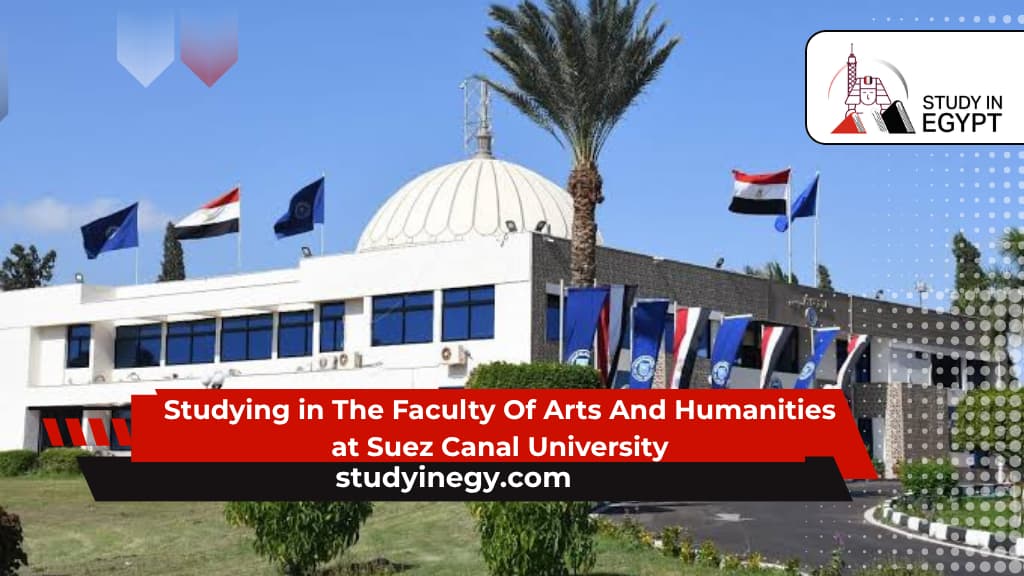
Studying in The Faculty Of Arts And Humanities at Suez Canal University … Artificial intelligence has imposed a new reality and radical transformations across all fields of work and all sciences, and everyone is now clearly asking: do specialists in the humanities still have a place in this reality?”
In this context, many believe that digital transformation is narrowing the demand for humanities disciplines, while the truth is that reality currently imposes a grey area filled with many challenges.
Nevertheless, the core of these humanities disciplines is fundamentally based on rejecting stagnation through pragmatism in dealing with every transformation and exploiting it in favor of professionals.
Therefore, the labor market still demands, and will continue to demand, professionals who combine: Analytical depth.
Linguistic proficiency.
The ability to work in constantly changing digital environments and capitalize on their challenges.
Accordingly, the Faculty of Arts and Humanities at Suez Canal University clearly realized this equation early on, and works according to it with full realism and responsibility on the ground.
This faculty was established in 2006, and today it includes nine distinguished academic departments ranging from languages to digital geography and psychology, through an approach that combines authenticity. In this article, we explain the most important educational strategies adopted by the faculty in order to implement its awareness of the necessity of keeping pace with everything new in the labor market reality. We also discuss its most important advantages and its most prominent diverse departments that make it a serious destination for international students seeking an experience with real impact.
Curriculum Development: A Clear Strategy Toward Keeping Pace With Changes
Real curriculum modernization does not mean replacing books with screens or adding useless theoretical updates. Rather, it means reformulating what the student learns so that it intersects with what the labor market actually needs in terms of qualitative updates to student skills, especially integrative skills.
In this context, these updates were fundamentally implemented and supervised by the faculty’s staff members who are directly engaged with the labor market environment. Accordingly, they focused on developing students’ creative and critical abilities toward machine and artificial intelligence outputs.
The faculty also realizes that these developments will have positive outcomes and that they will further expand the reality of the humanities and place them in a different environment that generates new forms of creativity.
The faculty has also invested significantly in developing new programs and specializations within its departments, particularly those continuously demanded by global labor markets. The most prominent examples include: The Specialized Translation Program for the English Language.
The Specialized Translation Program for the French Language.
The Geographic Information Systems and Remote Sensing Program.
All these specializations, in addition to others whose curricula and priorities the faculty continues to formulate, are currently the foundation for achieving the ambitious student’s goal of securing a solid position against any changes and dealing professionally with every challenge.
Practical And Applied Training: The Real Refinement Of The Professional Personality
It can be firmly stated that practical training is the decisive factor through which the ambitious and realistic student distinguishes between a responsible and professional institution that places preparing students for the labor market at the top of its priorities.
In the context of strengthening this commitment, the faculty has prepared specialized halls fully equipped technologically to serve its applied programs. These are not merely aesthetic additions, but rather an essential part of enhancing the effectiveness of the educational infrastructure upon which both academic evaluation and professional training are built.
The employment opportunities opened by this training are also broad and diverse: from media and translation to major scientific research centers, international companies, tourism, and the oil sector for geography graduates, as well as mental health and psychological care institutions for psychology graduates.
This diversity is a direct reflection of the nature of the curricula, which prepare students for varied and distinguished professional roles rather than one narrow career path that may be exposed to severe fluctuations. The international student who comes with a background of passion for linguistic or humanistic knowledge will find in this faculty and its educational strategy an integrated crucible that develops this background and transforms it into real professional capital.
Advantages Of Studying At The Faculty Of Arts And Humanities At Suez Canal University
Strengthening the student’s position of power when dealing with the labor market after graduation requires a number of vital elements that guarantee such a position.
In this context, the faculty has competently and responsibly provided these elements, creating an educational experience that serves as a strong professional passport in all regional and international labor markets. Within the framework of the integration of its experience and the enhancement of its efficiency, the following are the most prominent of these elements:
Academic Recognition And The Strong Value Of The Degree In The Labor Market
This distinguished university has recently achieved a respectable and academically strong position within several trusted international university rankings such as QS and SHANGHAI and others. This faculty has played a major role in strengthening this success through its great scientific efforts and the efficiency of its strategies.
At this faculty, the university degree you hold when dealing with the international labor market will be completely equivalent to those offered by European and American universities.
What further strengthens this is the competitiveness of graduates in the labor market, which can be measured through the structure of the programs, the assessment methods, and the diversity of employment paths opened by each department.
Advanced Educational Environment: Vital Integration In Service Of The Educational Experience
The faculty is witnessing noticeable and fruitful expansion in its infrastructure, with new buildings that include modern lecture halls with appropriate capacities and equipped with technological tools that support interactive learning.
However, the educational environment does not only mean buildings; the faculty belongs to a university that places clear importance on scientific conferences and research activity.
This gives the international student a distinguished opportunity to engage in real academic dialogue from the very first years, instead of merely remaining in the role of a recipient.
Reasonable Tuition Fees: The Decisive Factor In Student Considerations
The annual tuition fees for international students at the faculty amount to approximately 3,000 US dollars, in addition to a registration fee of 1,500 dollars paid only once.
This clearly demonstrates the large gap between the cost of studying in Egypt and the cost of studying in other countries.
Therefore, you will obtain a comprehensive and distinguished educational experience by every standard, whose most important goal is to prepare you for the labor market reality without bearing enormous financial burdens that hinder your great ambitions.
In addition, the cost of living in Egypt is characterized by its simplicity, ensuring a very suitable level of comfort and the availability of living necessities.
The Most Prominent Specializations Of The Faculty Of Arts And Humanities At Suez Canal University
The faculty includes nine academic departments distributed among languages, humanities, social sciences, and technical disciplines. The following is a brief overview of the most prominent ones:
English Language and Literature: One of the most popular departments, providing advanced linguistic and literary qualification along with a specialized translation track that opens broad international professional markets for students.
French Language and Literature: Combines high linguistic proficiency and French literature with a specialized translation program that covers the labor market needs of French-speaking African countries, which represent a huge and growing market.
Chinese Language: In light of Chinese economic expansion in Africa and the Middle East, this specialization represents a smart investment for those planning a professional path connected to these growing partnerships.
Geography and Geographic Information Systems: Includes a specialized program in surveying and remote sensing, which is a specialization witnessing rising demand in urban planning, resource management, and digital infrastructure sectors.
History and Civilization: Develops the ability to analytically read civilizational contexts, with direct applications in academic research and diplomatic and cultural work.
Philosophy: Builds critical thinking and logical analysis skills that are increasingly valued in consulting, media, and research work environments.
Psychology: Qualifies graduates to work in mental health institutions, rehabilitation centers, and support institutions for people with special needs, which is a sector witnessing noticeable growth in regional labor markets.
Sociology: Provides tools for analyzing social structures and dynamics, with applications in social policies, community development, and field research.
In short, the Faculty of Arts and Humanities at Suez Canal University provides international students with what they actually need to guarantee a stable position in the labor market and high job security: a recognized degree, programs designed for a real labor market, and all of that at a reasonable educational cost.