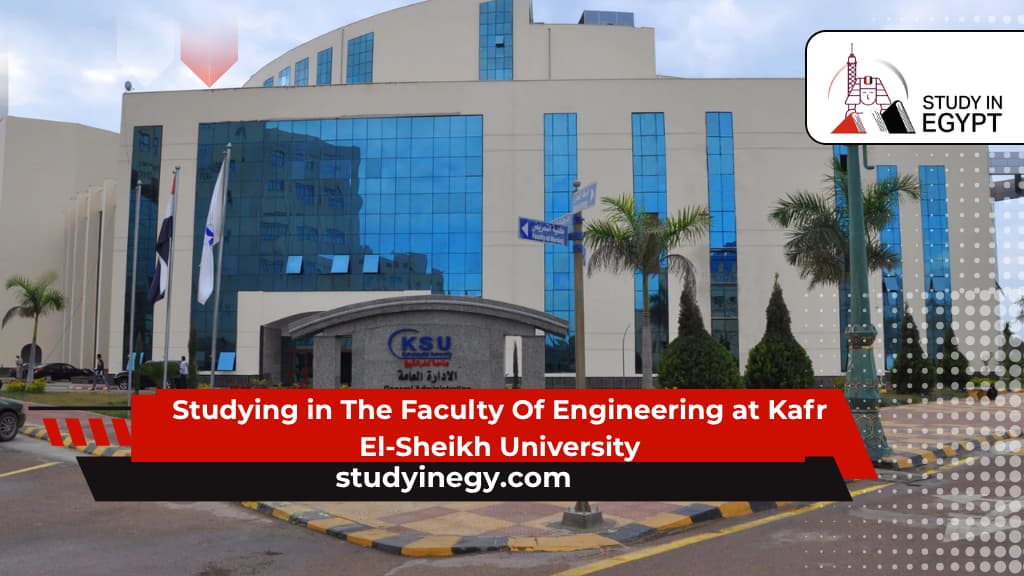
Studying in The Faculty Of Engineering at Kafr El-Sheikh University … In recent times, everyone has been asking: how effective is studying this field in a job reality that has been radically reshaped by artificial intelligence and other technological systems?”
Engineering is one of the oldest applied sciences and among the most important through its outputs that have changed the course of history entirely; in fact, it is what fundamentally draws that course. The cadres of this field have always been among the most competent and intelligent in turning any change to their advantage.
In this context, engineering is no longer merely theoretical technical drawings and mathematical calculations confined to books and outdated designs.
Engineering has become the main driver of the Fourth Industrial Revolution, from artificial intelligence to renewable energy and advanced infrastructure.
In light of this radical transformation and the necessity of confronting changes with full responsibility and pragmatism, the Faculty of Engineering at Kafr El-Sheikh University recognized this reality early on.
On this basis, the faculty worked on developing its academic programs and the structure and priorities of its curricula in a way that responds to the requirements of the contemporary labor market, making itself one of the fastest-rising engineering faculties in international rankings and distinguished scientific research.
In this article, we review the main key aspects that come to students’ minds regarding studying there and the effectiveness of its educational experience overall in a work reality that only grants opportunities to those who possess integrative abilities, full awareness, and applied conceptual coherence with what they have studied.
Keeping Up With Changes: Real Effectiveness Of The Reality Of Work And Its Requirements
The faculty has sought and continues to realistically and responsibly anticipate changes by reformulating its educational curriculum according to a clear strategic vision primarily aimed at equipping the student with integrative skills.
According to this vision, academic curricula and applied activities have undergone periodic qualitative reviews with noticeable positive impact, contributed to by a select group of academics and industrial experts.
This aims to ensure the compatibility of scientific content with modern technological trends.
The features of this development appear in the integration of programming, data analysis, and digital modeling courses within specialized engineering tracks that are significantly transforming their work reality.
This grants the student a dual knowledge wealth: depth in specialization, and flexibility and digital skills that open wide professional horizons toward excellence and resilience in the face of sharp waves of change.
To further enhance this path, the faculty has adopted diverse interactive teaching methods that combine: traditional lectures, group project work and computational simulations.
All of this is designed to make the learning process a rich and dynamic experience that goes beyond the classroom, creating a distinctive student personality that strengthens their position and skills in the labor market.

Practical Training: A Position Of Strength Is Built Through Application
The Faculty of Engineering at Kafr El-Sheikh University places great emphasis on practical training as a central pillar of its educational system.
According to this commitment, the faculty believes that true engineering competence is not built in books alone—despite their importance in forming foundational knowledge—but is refined in the field.
Therefore, accredited practical hours have been included in study plans for all specializations, including: laboratory experiments, integrated engineering projects, field visits to industrial facilities and advanced infrastructure.
In the same context, the faculty strengthens this pragmatic and responsible approach through partnerships with several factories, companies, and governmental institutions working in energy, water, communications, and construction sectors.
This provides students with internship opportunities and direct exposure to real work environments before graduation, strengthening their professional position in major labor markets.
Graduation projects also form a cornerstone of this integrated system, as students are required to design innovative real engineering solutions to actual problems.
This equips students with critical thinking and creative problem-solving skills—skills that occupy a high position in employers’ priorities internationally, because they are among the most important required skills to adapt to artificial intelligence systems, operate them, and modify their outputs with high precision and reliability.
Advantages Of Studying At The Faculty: Real Integration Of An Educational Experience With International Standards
Studying at this faculty, which is noticeably rising in global rankings due to its research and engineering student projects, provides an educational experience whose positive value becomes evident at the beginning of a student’s professional career.
This experience has been shaped by the faculty through several vital advantages that international students constantly seek, as they represent a guarantee for securing a stable foothold in regional and international labor markets.
Below are these advantages:
Real Value Of The Experience: Full Recognition Of The Faculty’s Curricula And Graduates
The Faculty of Engineering at Kafr El-Sheikh University is officially recognized by the Supreme Council of Universities in Egypt and a number of reputable regional and international academic institutions.
Accordingly, this faculty carries an academic reputation accumulated over years of scientific contribution, established through the research and specialized engineering consultancy of faculty members.
Major companies and digital and engineering institutions in global labor markets also recognize the competence and effectiveness of the faculty’s strategies, as well as the strong qualitative knowledge and practical background of its graduates.
Furthermore, real opportunities are opened for postgraduate studies in international universities that recognize the strong engineering competence of the faculty.
All these factors make the faculty’s degree a strong professional passport, granting its holder strong competitive advantages through a modern curriculum and wide academic and professional recognition.
The Educational Environment: A Key Element In Ensuring Strong Practical Performance
The campus of the Faculty of Engineering at Kafr El-Sheikh University is characterized by a modern educational infrastructure, topped by engineering laboratories equipped with the latest tools for realistic simulation of work environments and the necessary technical devices for conducting experiments and applied research across various specializations.
Smart classrooms also enable the use of interactive presentation technologies and digital learning platforms, enriching the learning experience and stimulating critical thinking and discussion skills among students.
The faculty also provides a comprehensive student support system, including: academic advising, office hours with faculty members, organized study groups.
University life is not limited to academics alone, as the faculty is rich with student activities such as unions, engineering competitions, and cultural events that allow international students to interact with their Egyptian peers and build human and professional networks extending beyond graduation.
Tuition Fees: A Cornerstone In The Student’s Decision Structure
The cost of studying at the Faculty of Engineering at Kafr El-Sheikh University is a striking competitive advantage for international students.
This is due to the faculty offering effective engineering education aligned with global standards at a significantly lower cost compared to well-known Western educational institutions.
Annual tuition fees at the faculty reach approximately 5000–6000 US dollars only, in addition to a 1500 US dollar registration fee.
In addition, the low cost of living in Egypt in general makes the overall educational experience economically viable without any compromise on academic quality.
Main Specializations Of The Faculty Of Engineering At Kafr El-Sheikh University
The Faculty of Engineering at Kafr El-Sheikh University is keen to offer specializations that match global market needs and reflect contemporary technological trends.
Mechatronics Engineering: A multidisciplinary field combining mechanical, electronic, and computer engineering.
This field is among the most in-demand in modern industries such as robotics and production automation.
This specialization reflects the faculty’s vision of graduating engineers capable of leading the wave of smart manufacturing.
Communications And Electronics Engineering: Establishes solid foundations in communication theory, network engineering, and signal processing.
It prepares graduates to work in telecommunications, digital systems, and applied electronics at a global level.
Computer And Information Engineering: Trains students in software engineering, operating systems, databases, and applied artificial intelligence—an indispensable specialization in the era of comprehensive digital transformation.
Production And Mechanical Design Engineering: Combines classical mechanical engineering foundations with computer-aided design and digital manufacturing tools, producing engineers capable of transforming ideas into executable industrial products.
Electrical Power Engineering: In a world rapidly moving toward renewable energy sources and smart grids, this specialization is gaining strategic importance.
It equips students with skills needed for solar energy, wind energy, and integrated power system management.
Irrigation And Hydraulics Engineering: Closely linked to one of the most urgent human challenges of the 21st century—efficient water resource management.
Its graduates are among the most in demand in infrastructure projects across African, Arab, and Asian countries.
In summary, choosing to study at the Faculty of Engineering at Kafr El-Sheikh University is not merely an academic decision; it is a conscious investment in a professional path shaped at the heart of a reality driven by the outputs of the Fourth Industrial Revolution.