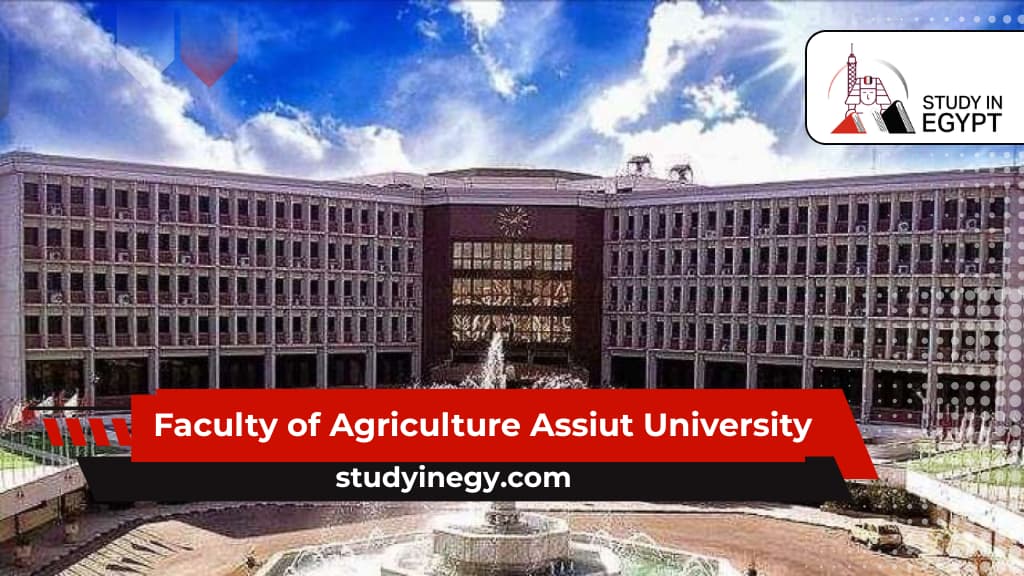
Studying at the Faculty of Agriculture Assiut University … Have you ever dreamed of being part of one of the oldest and most important economic fields since the beginning of history?
At the heart of one of the most important agricultural economic destinations in the Middle East and Africa, namely Upper Egypt, and specifically at the Faculty of Agriculture at Assiut University, the faculty stands not only as one of the oldest educational institutions in this field.
In fact, it is an educational system with its own vision and teaching methods that comply with the highest international standards in agriculture and its specializations to shape the future. Here, we do not teach agriculture in its traditional sense; rather, we formulate the concept of “Sustainable Food Security” with the tools of the twenty-first century.
Choosing the Faculty of Agriculture at Assiut University is not merely an academic step toward a traditional course of study; rather, it is joining an elite group of the most skilled researchers and innovators who transform environmental challenges into golden economic opportunities that keep pace with any digital developments, no matter how impactful they may be.
In this article, we seek to provide you with answers to all the questions that may be on your mind about studying at this faculty.
This is done by discussing and clarifying the most important points that have granted the faculty its prestigious status among dynamic academic institutions.
Smart Awareness And Keeping Pace With Rapid Changes In The Field Of Agriculture
The global work environment is changing at an unprecedented rate, and agriculture has long ceased to be merely “primitive farming systems and a small field.”
Therefore, the Faculty of Agriculture at Assiut University realized, with intelligence and conscious pragmatism, that we live in the era of Smart Farming.
Accordingly, the faculty did not settle for remaining within the scope of traditional teaching and theoretical education; rather, it revolutionized its curricula to professionally and efficiently align with global market requirements through:
- Advanced curricula: The faculty continuously updates its courses to include the integration of biotechnology fields (Biotechnology), nanotechnology in agriculture, and advanced water resource management.
- Intensive practical training: The faculty firmly believes in the principle of the vitality and professionalism of “learning by practice.” In this context, the faculty owns vast experimental farms, greenhouses that rely on hydroponics, and laboratories equipped with the latest technologies used in the job market. The student spends a training period that may reach more than 60% of his time applying what he has learned theoretically, which minimizes the gap between graduation and the labor market to the lowest possible level.
- Agricultural digitization: Students are trained to use Geographic Information Systems (GIS) and superior artificial intelligence in soil analysis and crop forecasting, making the Assiut graduate a “technological engineer” par excellence, who realizes that these elements are the most important supporting tools in the present and the future.
Why Choose The Faculty Of Agriculture At Assiut University?
The faculty includes an important and dynamic set of advantages that guarantee you, as an international student, a clear path toward excellence and a real competitive opportunity in a labor market full of challenges, such as the agricultural field and its specializations.
In this paragraph, we clarify for you the advantages that guarantee you an educational journey comparable to what you may obtain at the most successful faculties of agriculture and their specializations in the world.
International Accreditation And Recognition That Grants Real Competitiveness
The Faculty of Agriculture at Assiut University obtaining accreditation from the National Authority for Quality Assurance and Accreditation of Education (NAQAAE) and the most important global educational systems in the agricultural field is not merely a theoretical administrative procedure; rather, it is a certificate of recognition that the faculty’s educational standards match international standards.
Therefore, this feature represents a professional passport:
- Your degree is recognized in major international institutions, facilitating the procedures of “degree equivalency” for those who aspire to work abroad, especially in Europe and America.
- Research partnerships: The faculty is linked through cooperation protocols with major international universities, providing outstanding students with opportunities to exchange expertise, attend international conferences, and access the latest scientific developments before others.
- Labor market confidence: Major multinational agricultural companies regard the Assiut University graduate as a graduate at the highest level of professionalism and competence, due to their awareness of the professionalism and intelligence of the curricula he has studied.
Advanced And Innovative Educational Environment
This faculty does not merely provide “classrooms for study” but rather designs an environment that stimulates critical thinking, creativity, and integration with technology:
- Digital infrastructure: Lecture halls equipped with the latest interactive display systems, an internet network covering the campus, and a massive digital library that allows you access to the latest research papers and reliable international scientific journals free of charge.
- Specialized laboratories: The faculty possesses advanced “central” laboratories for precise analyses, where you will train on chromatographic separation devices and genetic analysis equipment used in major factories.
- Personality building: The faculty offers entrepreneurship clubs, agricultural innovation competitions, and scouting activities, which refine your communication and leadership skills (Soft Skills), so you graduate as an engineer who possesses knowledge and strength of character together, ensuring exceptional integration skills in the labor market.
Tuition Fees As A Smart Investment In Your Future
In a world where education costs are rising dramatically, Assiut University offers a brilliant solution that combines outstanding quality with fair cost:
Subsidized fees: As a prestigious governmental institution, tuition fees remain symbolic compared to the volume of practical training and resources consumed by the student. The student pays a one-time registration fee of up to $1,500, and simple annual fees ranging between $4,000–$5,000, at a time when tuition fees outside Egypt exceed tens of thousands of dollars.
Return on investment: Upon graduation, the skills you have acquired qualify you for jobs with rewarding salaries in the food manufacturing sector or large farms, which means recovering your “investment in education” in record time.
The Most Distinguished Specializations In The Faculty
The faculty includes a distinguished group of vital specializations in the agricultural field, which in fact constitute the most important requirements of the labor market.
This contributes to ensuring that the student’s specialization will have significant and demanded value to guarantee job security and financial return.
Department Of Crops And Plant Production
This department is considered the backbone of food security. In it, you will learn how to develop “healthy and productive” crops capable of withstanding drought, salinity, and climate change.
You will also study in the faculty’s vast fields how to manage field crops using the latest systems, qualifying you to become a production sector manager in major agricultural reclamation companies such as the “Mostaqbal Misr” project and “New Delta.”
Department Of Food Science And Technology
If you dream of working in major global food companies, this is your place. You will study food chemistry and microbiology and modern manufacturing methods. Most importantly, how to apply international quality standards (ISO & HACCP).
The graduate of this department is primarily responsible for the safety of what people eat, a role that is indispensable in any society, and any radical digital change will be a primary supporting factor for him.
Department Of Animal And Poultry Production
This department will qualify you to become a professional “Animal Production Manager,” where you will study:
- Animal physiology.
- Innovative feed formulations.
- Genetic improvement techniques to increase meat and dairy production.
The faculty ensures that training takes place in animal and poultry production farms and the faculty’s advanced apiaries, making you ready to manage large-scale projects or start your own animal production venture.
Department Of Plant Protection And Pesticides
Certainly, there is no benefit from agriculture if we do not protect the crop. In this department, you become a “preventive expert” who possesses the ability to diagnose agricultural diseases and pests and develop integrated pest management (IPM) plans.
You will learn how to use environmentally friendly biological alternatives and how to manage pesticide use safely, a specialization that is highly demanded in export farms subject to strict international supervision.
Department Of Agricultural Biotechnology (Biotechnology)
This is the most vital specialization, where the laboratory meets the field. You will learn tissue culture techniques, genetic engineering, and the use of genetic fingerprinting in plant and animal improvement.
Graduates of this department are the scientists of the future who innovate biological solutions to agricultural diseases and develop medicines and industrial products from plant origins, opening doors for you to work in international research centers and biotechnology pharmaceutical companies.
Department Of Soils And Water
In this department, you will become an expert in modern irrigation engineering (drip and sprinkler irrigation) and in reclaiming desert lands and transforming them into green paradises. You will learn soil analysis using satellite imagery and Geographic Information Systems (GIS), enabling you to manage natural resources efficiently to ensure their sustainability for future generations.