

Nuclear Engineering universities… There is growing demand in global labor markets for specialists in Nuclear Engineering. As a result, many students are increasingly interested in studying this field because of its promising career prospects. Therefore, many people ask about the best universities for studying Nuclear Engineering.
What is Nuclear Engineering?
Nuclear Engineering is the field concerned with the science and application of nuclear and radiation processes. These processes include the use of nuclear energy and the production and use of radioactive materials for research, industry, medicine and national security. Nuclear Engineering is founded on the principles of physics and mathematics that describe the nuclear reactions.
These physical phenomena depend on heat transfer, fluid flow, chemical reactions, and material movement when exposed to radiation. Therefore, Nuclear Engineering is essentially a multidisciplinary field that relies on several branches of physics.
The specialization is aimed at equipping students with the essential knowledge and practical skills to participate in the design, construction and operation of nuclear power plants and nuclear energy research. The field is essentially about strengthening nuclear infrastructure.
In addition, it focuses on exploring and researching new energy sources while emphasizing practical applications in nuclear energy, nuclear plants, and reactor design.
Many civil, military, industrial and scientific fields apply theories of nuclear engineering, depending on the institution or organization the professional works for.
Advantages of Studying Nuclear Engineering
Studying Nuclear Engineering provides students with exceptional job opportunities and high salaries while qualifying them to work in advanced strategic sectors such as clean energy, medicine, and nuclear research.
The specialization is distinguished by curricula that combine advanced physics with practical applications, ensuring graduates possess high-level skills that are in demand both locally and internationally, especially with the global shift toward peaceful nuclear energy projects.
Here are the أبرز advantages of studying Nuclear Engineering:
- Promising and prestigious career opportunities: The field allows graduates to work in major strategic projects such as the El Dabaa Nuclear Power Plant project in Egypt, as well as in nuclear reactors, particle accelerators, and medical devices.
- High salaries: Nuclear engineers are among the highest-paid engineering professionals, with an average annual salary of approximately $105,000.
- Future of clean energy: Nuclear Engineering is considered a primary source of clean, emission-free energy, making it a sustainable specialization for the future.
- Modern practical curricula: Universities such as Cairo University and Alexandria University provide advanced laboratories and simulation facilities that help students apply physics and mathematics in real engineering fields.
- Diverse specialization areas: Studies include nuclear fusion, plasma science, nuclear materials, radiation detection and measurement, and nuclear project management.
- Preparing engineers to lead technology: Students acquire skills in risk assessment, quality assurance, and nuclear licensing.
The study duration is usually four years, making it a strategic choice for students who wish to engage in advanced technology and contribute to national energy initiatives.
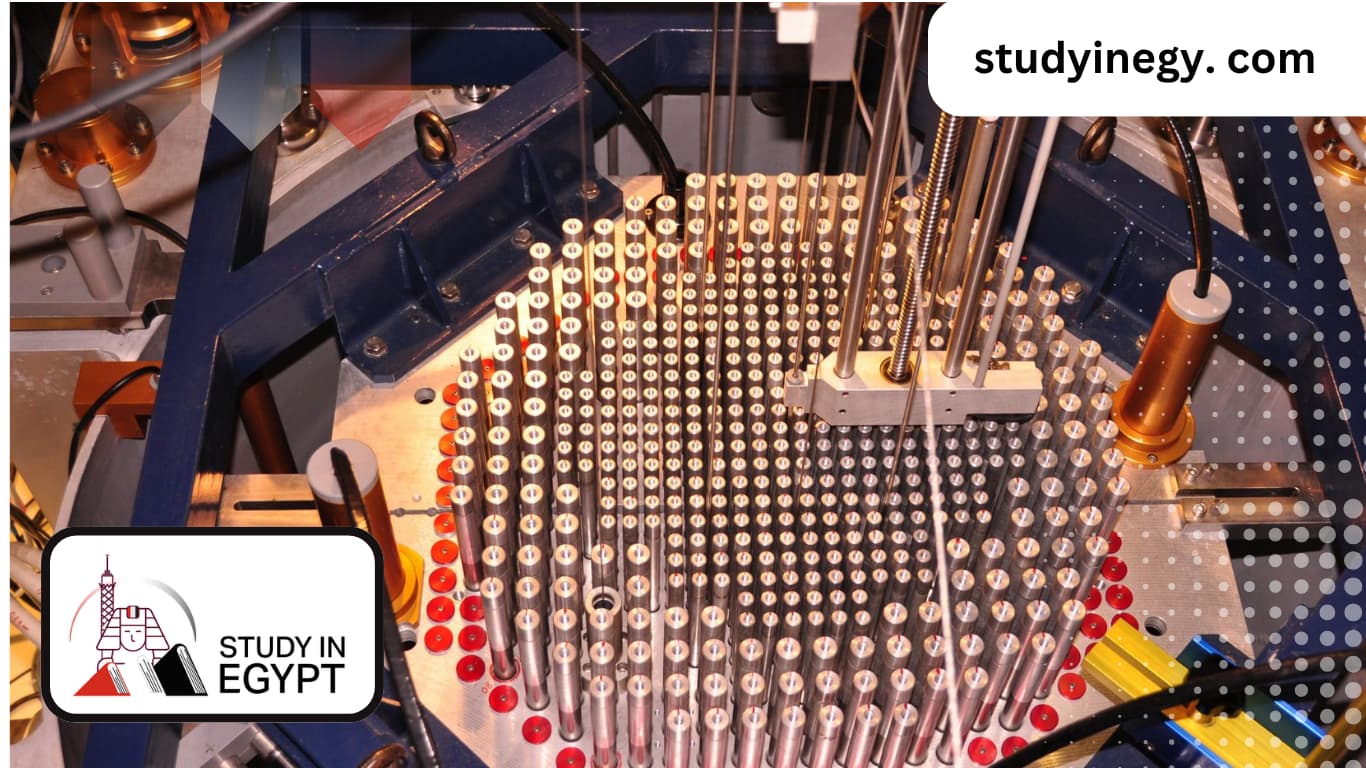
What is the Role of Nuclear Engineering?
Nuclear Engineering is one of the world’s largest industries, focused on developing and testing new applications to benefit from nuclear energy.
It is used to power submarines, ships, and spacecraft, as well as to generate electricity in power plants. Nuclear research in engineering also focuses on finding ways to make reactors safer and more efficient.
Nuclear energy also plays a major role in developing tools and equipment used in diagnosing and treating medical conditions, where nuclear engineers contribute to developing medical applications. Their research in nuclear science also extends to bioengineering and environmental science.
Safe Nuclear Engineering also focuses on managing and using nuclear energy safely, implementing safe operating procedures in nuclear facilities, disposing of nuclear waste, and monitoring facilities for any design or operational violations that may harm humans or violate safety laws.
Nuclear engineers have the authority to shut down nuclear facilities in emergency situations. In the event of a nuclear incident, they analyze the cause and implement preventive measures.
What Do Nuclear Engineers Do?
Nuclear engineers typically perform the following tasks:
- Design or develop nuclear equipment such as reactor cores, radiation shielding systems, and related devices.
- Supervise the operation and maintenance of nuclear power plants to ensure compliance with safety standards.
- Write operational instructions for nuclear plant operation and nuclear waste handling and disposal.
- Monitor nuclear facility operations to identify any practices that violate safety regulations and laws.
- Conduct experiments to test methods for using nuclear materials, recovering nuclear fuel, or disposing of nuclear waste.
- Take corrective measures or order plant shutdowns during emergencies.
- Investigate nuclear accidents and collect data used to design preventive measures.
- Work on developing applications of nuclear materials for medical imaging devices such as CT scanners.
- Design and develop cyclotrons that produce high-energy beams used in healthcare to treat cancer tumors.
Careers for Nuclear Engineers
- Atomic Operations Engineer
- Nuclear Radiation Engineer
- Nuclear Steam Supply System Engineer
- Radiation Engineer
- Reactor Engineer
- Reactor Project Engineer
Best Universities for Studying Nuclear Engineering
The United States and European universities are considered among the top destinations for studying Nuclear Engineering.
Best Universities for Nuclear Engineering in the United States
- University of Michigan
- Massachusetts Institute of Technology
- University of Nevada, Las Vegas
- Virginia Commonwealth University
- University of California, Berkeley
Best Universities for Nuclear Engineering in the United Kingdom
- University of Birmingham
- Imperial College London
- Lancaster University
- University of Leeds
However, despite the many advantages of these universities, there are also some drawbacks.
Disadvantages of Studying Nuclear Engineering in American and European Universities
Studying Nuclear Engineering at prestigious American and European universities offers high-quality education, but it also comes with several academic, professional, and personal challenges:
- High tuition fees: Tuition fees in American universities range from $26,000 to $52,000 annually, while in the UK they range from €25,000 to €30,000 annually.
- High living expenses: Students may have to pay significant amounts for basic necessities. The average rent for a small room in a university city in the US or UK may exceed $1,200–$1,500 per month.
- Healthcare costs: The health insurance system in the United States is particularly complex and expensive, and even minor medical emergencies can result in significant expenses beyond basic student insurance coverage.
- Daily service expenses: Costs for services such as laundry, haircuts, internet subscriptions, and utilities are often much higher than in Arab countries.
For these reasons, many students find Egyptian universities to be an ideal choice for studying Nuclear Engineering.
Studying Nuclear Engineering in Egyptian Universities
The best universities for studying Nuclear Engineering in Egypt offer advanced educational programs that match international standards while providing a supportive learning environment for international students. Their educational strategies combine detailed academic curricula with practical training in real work environments such as the El Dabaa Nuclear Power Plant project.
Egypt currently stands out as an active hub in the nuclear field thanks to the El Dabaa Nuclear Power Plant project, giving international students a competitive advantage comparable to studying in Europe or the United States, especially since the curricula and educational strategies are similar.
Egypt also offers international students access to distinguished scientific infrastructure. The presence of Egypt’s Second Research Reactor at the Nuclear Research Center in Inshas serves as a fundamental training facility for students. Universities also provide specialized laboratories in radiation protection, nuclear physics, control systems, and reactor operation simulators that allow students to train in complex operational scenarios within a completely safe educational environment.
The quality of education provided by Egyptian universities in Nuclear Engineering is internationally recognized. Egyptian international universities are ranked globally alongside American and European universities, making their degrees internationally equivalent in value.
These degrees gain additional global recognition through curriculum alignment with standards set by the International Atomic Energy Agency (IAEA), as well as dual-degree programs offered by some private universities in partnership with institutions such as Tomsk Polytechnic University in Russia. This enables international graduates to obtain degrees recognized in the European Union and Russia.
Egypt’s participation in engineering cooperation agreements also qualifies its graduates to join international engineering syndicates and work in major nuclear projects worldwide, especially with the practical experience gained through involvement in the global El Dabaa Nuclear Power Plant project.
Tuition Fees for Studying Engineering in Egypt for International Students
International students pay a one-time registration fee of only $1,500 during the first academic year, which is unified across all university levels.
Annual tuition fees are $5,000 for undergraduate studies and $5,500 for postgraduate studies.
These fees are considered very affordable compared to the tuition costs of similar programs at the same academic level and with equivalent international degree value at other global engineering colleges. Egyptian universities aim to provide all possible facilities for international students, especially students from Arab countries, to benefit from the promising career opportunities offered by engineering programs in Egypt.
Students enroll in colleges that provide outstanding global educational standards using the latest technologies available in major international universities, within institutions distinguished by a rich historical legacy. For example, the Faculty of Engineering at Cairo University is considered the oldest engineering faculty in the Middle East.
أبرز Engineering Faculties in Egyptian Universities
- Faculty of Engineering, Cairo University (Public University)
- Faculty of Engineering, The American University in Cairo (Private University)
- Faculty of Engineering, German University in Cairo (Private University)
- Faculty of Engineering, Al-Azhar University (Public University)
- Faculty of Engineering, Ain Shams University (Public University)
- Faculty of Engineering, Zagazig University (Public University)
- Faculty of Engineering, Assiut University (Public University)
- Faculty of Engineering, Minia University (Public University)
- Faculty of Engineering, Alexandria University (Public University)
- Faculty of Engineering, Misr International University (Private University)
- Faculty of Engineering, Arab Academy for Science, Technology and Maritime Transport (Private University)
- Faculty of Engineering, October University for Modern Sciences and Arts (Private University)
- Faculty of Engineering, The British University in Egypt (Private University)
- Faculty of Engineering, Future University in Egypt (Private University)
- Faculty of Engineering, Misr University for Science and Technology (Private University)
Requirements for Studying Engineering in Egyptian Universities for International Students
- The student must hold a valid passport. If the student is the child of an Egyptian mother, this must be declared during registration, and the student must not hold Egyptian nationality.
- For undergraduate admission, the student must have a high school certificate or equivalent with grades meeting the Egyptian engineering college admission requirement of 65%.
- For master’s admission, the student must hold a bachelor’s degree with at least a “Pass” grade from a university recognized by the Egyptian Supreme Council of Universities.
- For doctoral admission, the student must hold a master’s degree with at least a “Pass” grade from a university recognized by the Egyptian Supreme Council of Universities.