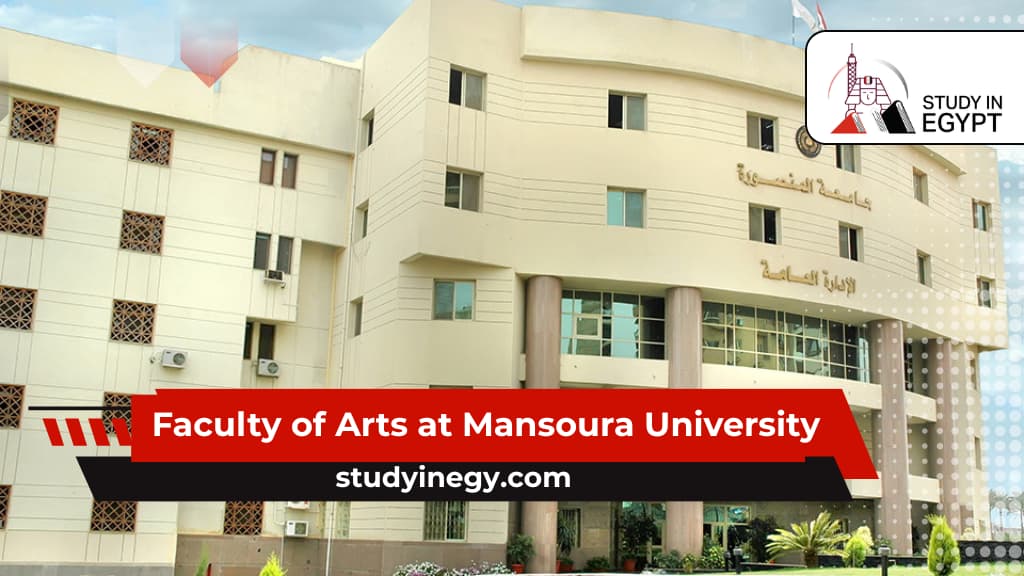
Studying in the Faculty of Arts at Mansoura University.
Many ambitious students who are considering enrolling in Faculties of Humanities, such as Faculties of Arts, wonder about the future of these fields in the age of artificial intelligence.
In fact, the digital transformations known as the “Fourth Industrial Revolution” have had a profound impact on the work environment of “white-collar” professionals. These changes have been multifaceted, offering both remarkable advantages and noticeable challenges.
Therefore, the Faculty of Arts at Mansoura University recognizes, with pragmatic awareness, the responsibility it bears in keeping pace with the rapid transformations reshaping the labor market and the global academic landscape.
In this context, the faculty has not merely acknowledged these changes or taken a passive observer’s stance; rather, it has exerted—and continues to exert—significant efforts toward implementing effective updates within its educational experience.
These updates primarily focus on one key approach: how to transform challenges into opportunities through a practical translation of academic study into real-world application, rather than relying on hollow development slogans that yield no tangible positive outcomes.
In this article, we provide a detailed explanation of the most important answers to students’ questions regarding the effectiveness of these curricula and educational strategies in light of current rapid changes and whether they truly ensure the development of sustainable capabilities to keep pace with them.
We also highlight their key advantages that form a distinctive integrative model, as well as discuss the most prominent and specialized academic programs offered.
Developing Educational Strategies: Do They Truly Qualify You To Keep Pace With The Job Market?
The faculty adopts flexible educational strategies that undergo continuous professional review to ensure alignment with all technological and scientific developments.
The curricula do not merely provide traditional knowledge rooted in outdated realities, as this would no longer be effective; instead, they reflect the current labor market through periodic updates that include the following:
- Integrating artificial intelligence technologies into translation.
- Modern methods of social research.
- Digital analysis of historical and geographical data.
This integrated and practical approach ensures that what students study in classrooms is a true reflection of current professional requirements, rather than obsolete theoretical knowledge.
Thanks to this approach, the model shifts from a “passive recipient” to an “active researcher” who is analytical, critical, and capable of using digital technologies as tools rather than competitors.
The faculty also offers distinguished services in “blended learning” and “digital platforms” equipped with the latest research tools and reliable scientific resources, expanding knowledge horizons and facilitating the learning process for international students as much as possible.
Thus, the core of the faculty’s strategy lies in the “quality of the academic output” and its real-world strength. The true measure is not the number of study hours or outdated curricula, but the extent of applicable skills acquired for international work environments that grant job security only to truly specialized individuals who are integrated with ongoing changes.
Practical Training: The Crucible Of Skill Development And Real-World Exposure
Practical training at the Faculty of Arts, Mansoura University, is a fundamental pillar in refining students’ skills and applying what they have learned in classrooms.
It is not merely about applying lessons or spending long hours on unproductive tasks; rather, it simulates, with high accuracy, the real professional environments students will encounter in the future.
To strengthen and enhance the effectiveness of this training, the faculty has established several distinguished strategic partnerships with leading institutions and research centers at both local and regional levels.
This direct exposure to the “real work environment” is essential, as it eliminates students’ apprehension and equips them with both technical (Hard Skills) and behavioral (Soft Skills) competencies, giving them a competitive advantage in the job market.
For example, translation students train in international work environments that present them with realistic complexities, particularly in specialized fields such as legal, literary, and medical translation.
Similarly, students of psychology and sociology engage in community institutions and specialized clinics under the supervision of leading professors and experts in scientific and field research.
Faculty Advantages: Integration And Balance That Ensure A Positive And Effective Experience
The faculty offers a range of competitive advantages that make it a suitable destination for international students.
Students seek a clear equation that ensures a competitive position upon graduation and entry into the international labor market. This equation consists of essential advantages, most notably:
Strength Of The Degree: Reputation And Wide Recognition In Global Work Environments
The faculty’s programs enjoy wide regional and international accreditation. Mansoura University is consistently ranked among advanced positions and continues to improve in prestigious global rankings such as “Shanghai” and “Times,” and it has obtained the ISO 9001 international quality certification.
This recognition is not merely theoretical or a “stamp on a certificate”; rather, it is a professional “passport” that grants graduates a competitive edge and strong positioning to work in international institutions, NGOs, or pursue postgraduate studies at top global universities without complex equivalency requirements, due to its compliance with international academic standards.
Integrated Educational Environment: Encouraging Scientific Research And Developing Social Skills
The faculty includes a teaching staff of highly accomplished academics and practitioners with extensive international experience, combining high academic qualifications with real field expertise.
The educational environment is distinguished by the availability of facilities equipped with:
The latest technological tools.
Advanced language labs and simultaneous translation systems.
Media studios that simulate real work environments.
Digital libraries provide access to the latest global research.
All of this operates within a framework of “academic responsibility” that fosters a stimulating environment for students, providing them with personalized guidance to ensure their rapid integration into the educational system.
The faculty also emphasizes student involvement in extracurricular, sports, and cultural activities to develop personality and social skills—an essential component of professional leadership and teamwork.
Affordable Tuition Fees: A Key Consideration For Students
The annual tuition fees at the faculty are considered a competitive and attractive advantage for students seeking a balance between high value and reasonable cost.
The annual tuition fees are approximately $3,500, with a one-time registration fee of about $1,500.
These costs are relatively affordable compared to similar faculties abroad, where tuition can reach several times this amount, placing a heavy financial burden on students, while the Faculty of Arts at Mansoura University offers comparable practical value.
Faculty Specializations: Diversity That Meets Varied Aspirations And Interests
The faculty offers several programs carefully designed to meet the demands of the digital age and global cultural exchange. The most important of these specializations include:
Department Of Languages And Literature (English, French, Italian, Chinese):
These departments focus on preparing translators and researchers with professional-level language skills (C2–C2), meeting the requirements of both simultaneous and written translation in international institutions, especially in fields that demand the highest levels of accuracy and reliability.
As part of real adaptation, students are trained in the latest Computer-Assisted Translation (CAT Tools) and delve into comparative cultural studies, as well as localization skills, which have become increasingly and sustainably in demand.
These departments aim to create a bridge of cultural communication, opening wide career opportunities in diplomacy, international cooperation organizations, and global news agencies.
Department Of Geography And Geographic Information Systems (GIS)
This is one of the leading departments that integrates classical geographical studies with advanced digital technologies for analyzing complex and large-scale spatial data.
Students receive intensive training in remote sensing technologies and smart mapping applications used in urban planning, environmental management, and logistics industries.
This specialization provides analytical and practical skills that make graduates indispensable, as technology will always remain a tool in their hands rather than a competitor.
Department Of Media
The department offers a comprehensive program covering journalism, radio, and television, with a strong emphasis on “digital media” and content creation using advanced technologies such as artificial intelligence.
Students are trained in fully equipped studios that simulate real broadcasting environments, while developing skills in preparation, presentation, and editing. Graduates are prepared to be versatile professionals capable of working as independent content creators, media consultants, or editors in major media institutions and digital platforms.
Department Of Applied Psychology And Sociology
This specialization moves from theoretical frameworks to applied clinical and social practice, where students are trained in:
Psychological assessment tools.
Social analysis.
The program aims to produce specialists capable of working in therapeutic institutions, human resource development centers, and organizational change management. It equips students with the ability to understand and influence human behavior in ways that enhance productivity and social stability.
Department Of Archaeology And Greek And Roman Studies
This department offers a unique experience combining historical study with field excavations, benefiting from the region’s rich archaeological heritage.
Students are trained in modern restoration techniques and scientific heritage site management in line with global standards. Graduates are qualified to work in international museums, archaeological missions, and specialized tourism sectors seeking highly competent experts.
In conclusion, a graduate of the Faculty of Arts at Mansoura University does not merely hold a degree in the humanities but rather possesses a combination of analytical skills and technical capabilities demanded by today’s labor market.