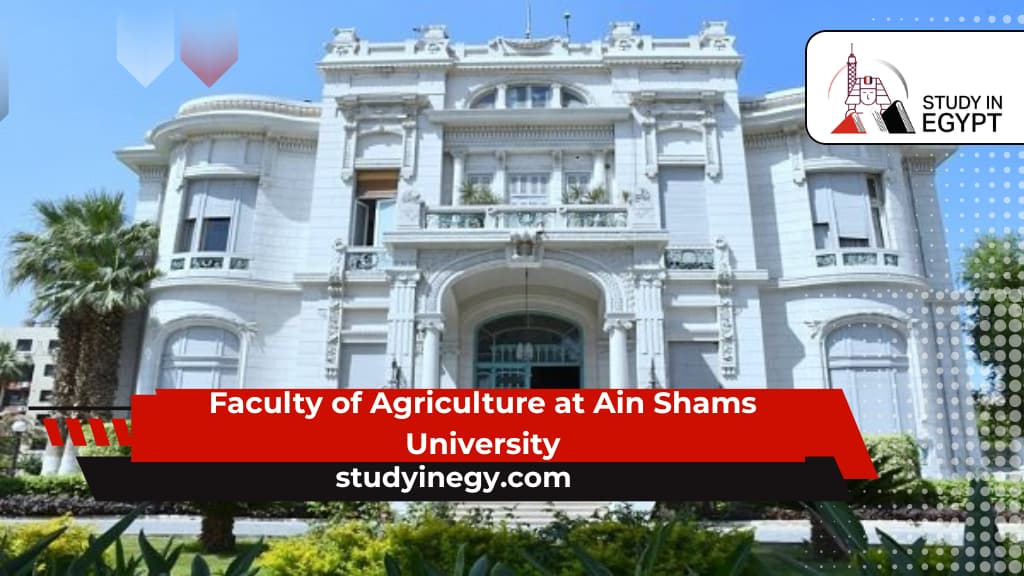
Studying at the Faculty of Agriculture at Ain Shams University … We live in a world where time accelerates at an unprecedented pace and where the concepts of industrial and practical work environments are shifting in the face of radical digital transformations.
Yet, there remain economic fields that are constants that do not bend and institutions that do not settle for standing on the ruins of the past, no matter how prestigious and weighty it was.
In this context, the Faculty of Agriculture at Ain Shams University in Egypt stands out not merely as an educational institution; it is truly a “laboratory that keeps pace with the present and the future” that has redefined the profession of the agricultural engineer from being a traditional technician in the field to a leader in the system of advanced biological and digital innovation.
Some may mistakenly believe that “agriculture” is a science associated with the past and has become obsolete due to the astonishing digital transformations.
But within the corridors of the Faculty of Agriculture at Ain Shams University, you will realize that this field is the winning bet of the twenty-first century and certainly beyond, because it is linked to human survival, and any digital advancement will only be in service of the distinguished agricultural engineer.
Why Study in Faculty of Agriculture at Ain Shams University?
In this successful faculty, you do not study traditional curricula that are no longer useful in the reality of the job market; rather, you learn how to harness technology for your benefit, control genes, manage global supply chains, and create a secure future for humanity and certainly a financial return and great job security for you.
In this faculty, we clarify for you the points about studying at the Faculty of Agriculture at Ain Shams University, the extent of its development and alignment with the labor market, and what the most important advantages it provides are.
Pragmatic Intelligent Awareness Of The Inevitability Of Development And Creativity
The Faculty of Agriculture at Ain Shams University was established a long time ago, specifically in 1942, to be an advanced applied edifice in the field of agriculture.
Therefore, when we speak of “heritage,” we speak of decades of accumulated expertise within this faculty.
But the true distinction of this faculty lies in its rejection of outdated and impractical rigidity at a time that, without exaggeration, brings something new almost every hour.
Thus, the faculty administration realized early on that the “big name” alone is not enough, so it embarked on a journey of smart and realistic transformation toward development and viewing changes as opportunities.
Today, the faculty integrates the foundations of classical agricultural science with the latest outcomes of the Fourth Industrial Revolution and its outputs of advanced artificial intelligence and also physical artificial intelligence.
The excellence here lies in the professional qualification of the graduate’s mindset, who leaves its gates mastering the language of data, remote sensing tools, and “smart farming” technologies.
It is the faculty that proved that strong roots in history are what allow branches to reach the sky of technology in favor of a field that does not know extinction.
Agriculture As A Field That Does Not Perish In The Era Of Major Transformations
If you are looking for a specialization that guarantees you a sustainable job future, then certainly one of your best options will be the agricultural field, as food is the permanent hard currency.
Moreover, with global challenges such as climate change and population growth, agriculture has transformed from a “profession” into “national and global security.”
Full And Intelligent Alignment With Biological Developments
We must also realistically and professionally recognize that the shape of the field has completely changed; agriculture now is
- Internet of Things (IoT): Sensors that monitor soil moisture and send alerts to your phone.
- Artificial Intelligence: Software that predicts agricultural epidemics before they occur.
- Biotechnology: Engineering crops that resist drought and double production.
Therefore, the question you may ask is, “How did the Faculty of Agriculture at Ain Shams keep pace with this transformation?”
In fact, the faculty did not stand as a spectator or opponent to change and development; rather, it carried out a comprehensive and smart restructuring of its curriculum to include these modern technologies.
The curricula are not merely theoretical books but a realistic technical roadmap that integrates biological sciences with programming and digital analysis, making the graduate an “interdisciplinary engineer.”
Intensive Practical Training
This is the core point that distinguishes agriculture at Ain Shams, and it is also what supports the student in keeping pace with the reality of the labor market.
The faculty firmly believes that knowledge that is not applied is knowledge that cannot withstand challenges and changes.
Therefore, it has established a training system considered among the strongest in the region, which includes:
- Advanced educational farms: The faculty owns vast training spaces and advanced research stations that allow the student to practice what he has learned in a real environment.
- Partnerships with the private sector: There are cooperation protocols with major agricultural and food industry companies in Egypt and the Middle East, granting students the opportunity for productive engagement with the real labor market during their studies.
- Accredited laboratories: The faculty includes laboratories equipped with the latest standard devices, where the student learns how to conduct chemical and microbiological analyses required by major factories.
- Applied projects: The student does not graduate without completing a practical project that solves a real problem, transforming the “graduate” into an “expert” who possesses confidence and skill.
Why Choose The Faculty Of Agriculture At Ain Shams University?
The international student looks for a specific set of important advantages that guarantee a clear path toward excellence and a confident launch into the labor market.
This is exactly what this integrated faculty provides by offering many advantages, most notably the following:
Integrated Educational Environment
The faculty is not merely theoretical lecture halls; it is an integrated community that includes large libraries, advanced scientific laboratories, and active student activities that build the students’ leadership personality.
Internationally Accredited Degrees
This point is the most important for the international student, to ensure that he has the opportunity to work in the most important agricultural economic institutions and companies in regional and international labor markets.
The faculty prides itself on obtaining accreditations and a balanced standing from the most important local, regional, and international bodies. This means that your degree is globally recognized and opens the doors to work in international organizations and cross-border projects.
Reasonable Tuition Fees Compared To The Acquired Scientific Value
Despite the educational quality that rivals the finest international universities, the faculty remains committed to offering these programs at affordable tuition fees, making it capable of achieving the most difficult equation: the highest quality at the best price.
The annual tuition fees for the faculty range between 4000 and 5000 US dollars, and the student pays a registration fee of only 1500 dollars once.
The Most Important Departments And Vital Specializations In The Faculty
The faculty includes a vital group of departments that meet the diverse needs of the labor market, including:
- Department of Biotechnology: The “golden” department that deals with genetic engineering and its medical and agricultural applications.
- Department of Food Industries: To graduate experts in food manufacturing and quality, which is the driving nerve of major food factories.
- Department of Agricultural Economics: Focuses on project management, economic feasibility, and international trade.
- Department of Plant Protection and Plant Diseases: The first line of defense to protect crops from pests using smart biological methods.
- Department of Animal and Fish Production: This specialization has a vital role in meeting market needs for meat, dairy, and fish resources in sustainable ways.
- Department of Soils and Water: The department concerned with managing water resources and modern irrigation solutions in light of water scarcity.