
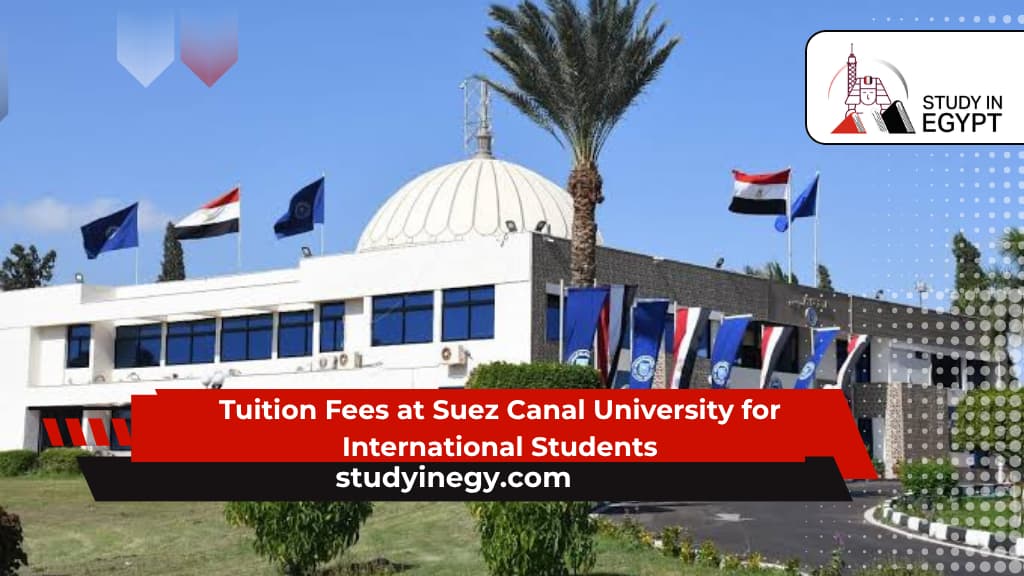
Tuition Fees at Suez Canal University for International Students … Choosing a university to study abroad is a vital decision for international students that begins with one question: what do I need to secure a stable foothold in this competitive reality? Suez Canal University provides a realistic answer to this question, without any hollow slogans, through an educational experience that is among the smartest and most successful among major higher education institutions on several regional and international levels.
Since its establishment in 1976, the university has grown from only three faculties—as a solid foundation and an early remarkable success—into a more efficient academic system with the latest strategies, comprising more than twenty faculties distributed across four branches in Egypt’s most important cities.
This expansion was not merely an increase in numbers and buildings; rather, it was a gradual, carefully planned, and responsible development in the university’s ability to cover several diverse fields that form the core of the economy and the financial movement of the international labor market.
The university covers fields ranging from medicine, pharmacy, and engineering to agriculture, commerce, and the humanities, making it a destination capable of accommodating different academic goals under one institutional umbrella.
Today, large and increasing numbers of international students from multiple nationalities study at Suez Canal University, trusting in the university’s experience that places reliability and transparency at the top of its priorities.
In this article, we review the most important aspects and vital points that students ask about regarding studying at this university, through several key topics including its faculty, tuition fees, the real advantages of its educational experience, and its current position toward the vital changes in work environments.
What Are the Main Advantages of Studying at Suez Canal University for International Students?
If we think deeply about the equation of the international student and the way they formulate the most suitable, comprehensive, and balanced choice, we will find that most of their focus revolves around whether this educational experience and its outcomes truly possess distinction and competence when dealing with global labor markets.
The answer to this question lies in several fundamental factors that ensure this clear path toward that goal, and this is what Suez Canal University distinctively provides through the following:
Remarkable Rise in Rankings: A Degree with Strong Value in Global Labor Markets
Suez Canal University has achieved a remarkable and distinguished rise within advanced positions in the most important global academic rankings such as QS, Shanghai, and others, over consecutive years.
This also comes with a strong and rising presence among prominent positions at the regional and local levels, and this rise is based on objective standards that include the following:
- Academic reputation.
- The rate of research citations and their effectiveness.
- Graduate employability in the changing work environment.
This significant academic standing positively reflects on the professional value of the degree in major work arenas across different fields, which recognize and rely on the competence and efficiency of this university’s graduates, as the university focuses on the quality of its specialized curricula.
Therefore, the student will obtain a degree that can be described as a “professional passport” with full regional and global accreditation and recognition across all professional and academic scientific levels.

Intensive Practical Training: The Path Toward a Personality with High-Quality Integrative Practical Experience
This point is considered one of the most important things sought by ambitious students who understand the current reality, because intensive and effective practical training on simulation systems and real-world interaction is exclusively what guarantees students the skills required by the labor market.
All university faculties such as medicine, pharmacy, engineering, agriculture, and the humanities operate according to a clear model that combines training inside laboratories and university facilities with field training in external institutions cooperating with the university.
This interaction within different work environments and training on all the points students fear facing produces something that classroom seats alone cannot create: a conscious professional who knows how to read the context within a challenge-filled environment before taking action.
This comes as a result of the faculty’s awareness of the principle of nourishing the student’s ambition and passion for excellence in their specialization by integrating them into the heart of the reality they will encounter after graduation. It also comes through equipping them with specialized skills that make them capable of facing any challenges and taking advantage of all changes in their favor within a strong pragmatic professional mindset.
The University Environment: Great Efforts Toward Providing the Experience for International Students
The number of international students at Suez Canal University exceeds hundreds of students, a figure that reflects a continuous history of welcoming international students and providing a comprehensive system to serve them.
The university exerts efforts within governmental directives that establish a clear institutional framework for receiving foreign students and facilitating their administrative procedures in order to accelerate their integration into the educational process.
In the same context, the university’s faculties organize periodic scientific conferences addressing vital topics that concern these students, such as:
Artificial intelligence.
The role of language in civilizational communication in the age of digitalization.
Participation in these conferences is also counted among the requirements for obtaining the academic degree, meaning that the international student finds themselves an active party in academic dialogue from the early stages of their studies.
Undergraduate Tuition Fees: The Cornerstone in the Student’s Equation
As a prestigious Egyptian public university, Suez Canal University’s fees for international students remain highly competitive and proportional in shaping the students’ integrated experience.
An additional amount of 1,500 US dollars is added to the annual tuition fees and paid only once upon the initial registration, which is the registration fee.
Below are the annual tuition fees categorized by each faculty:
Faculty Annual Tuition Fees in US Dollars
- Faculty of Medicine: 6,000
- Faculty of Dentistry: 6,000
- Faculty of Pharmacy: 5,000
- Faculty of Engineering: 5,000
- Faculty of Computers and Information: 5,000
- Faculty of Veterinary Medicine: 4,000
- Faculty of Agriculture: 4,000
- Faculty of Science: 4,000
- Faculty of Nursing: 4,000
- Humanities and Social Faculties (Commerce, Arts, Education, Al-Alsun, and others): 3,000
Therefore, these tuition fees constitute a real advantage for students seeking a balanced and realistic integration among the factors of study.
The Most Prominent Requirements for Studying at Suez Canal University for International Students
The requirements for studying at this university are also characterized by great simplicity and the absence of major complications. Below are the main requirements for both undergraduate and postgraduate studies:
- The applicant must be a non-Egyptian citizen.
- Obtaining a high school certificate or its equivalent.
- Submitting a recent academic equivalency certificate accredited by the Egyptian Supreme Council of Universities.
- A copy of a valid passport.
- A nomination letter from the competent governmental or educational authority in the student’s country.
- Approval from the Egyptian embassy in the student’s country for enrollment at the university.
- For a master’s degree: an accredited undergraduate degree recognized by the Supreme Council of Universities with at least a “Pass” grade.
- For a doctoral degree: an accredited master’s degree in addition to the undergraduate degree, with at least a “Pass” grade.