
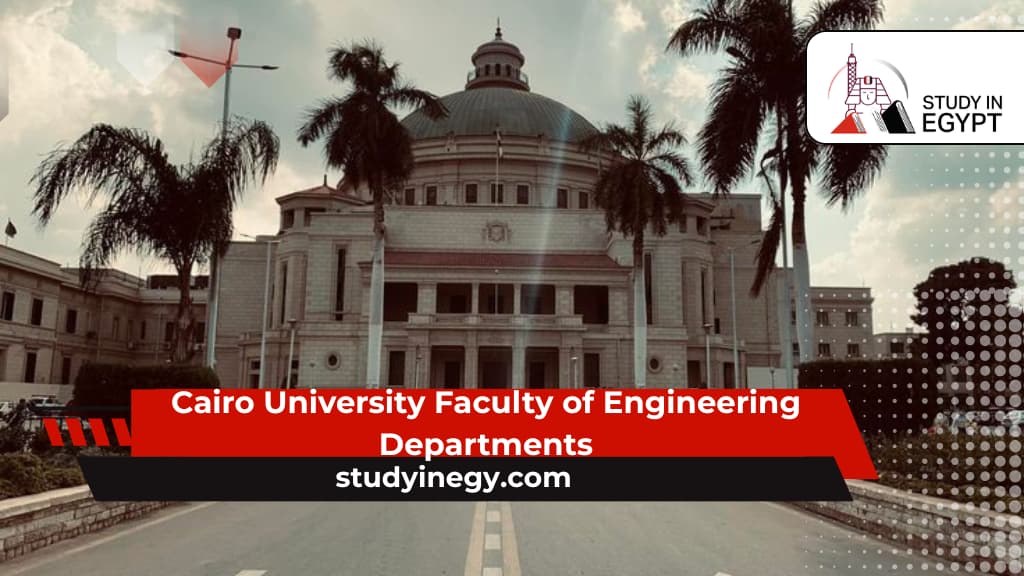
Cairo university faculty of Engineering departments … Cairo University Faculty of Engineering (CUFE) stands as a monumental pillar of engineering education in the Middle East and Africa. Established on a foundation of excellence and innovation. CUFE is not just an institution—it is a launchpad for world-class engineers prepared to meet the demands of a rapidly evolving global and national landscape.
Get to know the unmatched advantages of studying at CUFE, including providing high-quality education that equals the best schools of engineering in the European, American, and Asian countries, and also uncover the overview of its diverse and vital departments, highlighting areas of current market demand.
The Distinct Advantages of Cairo University Faculty of Engineering (CUFE)
Choosing CUFE means opting for an education that is academically rigorous, globally recognized, and deeply connected to industry and national development.
Global Recognition and Accreditation
This school of engineering at Cairo University consistently ranks highly in international university assessments (such as QS and Times Higher Education). It cements its reputation as a premier engineering school. The same as the best ones in the United States, Germany, the United Kingdom, Canada, Australia, Singapore, Switzerland, Japan, the Netherlands, South Korea, and more.
Education Quality that meets the best International Standards
The faculty’s programs are regularly updated to align with global engineering curricula. Notably, the Architectural Engineering and Technology program has received multi-year international accreditation renewal from UNESCO and the International Union of Architects (UIA).
CUFE offers its programs by providing both academic and practical curricula, making the student graduate while recognizing all related to the field of study wether practically or academic, and getting in-depth and comprehensive training with using the latest updates.
This school is accredited by the National Authority for Quality Assurance and Accreditation of Education (NAQAAE), ensuring that its educational and administrative processes meet rigorous national quality benchmarks.

Rich Legacy and Vast Network
With a history dating back over a century, CUFE has trained generations of prominent engineers, leaders, and policymakers in Egypt and the Arab world.
Graduates form a powerful, influential network across all sectors—from major construction projects and government infrastructure to cutting-edge technology companies—providing unparalleled career opportunities and mentorship.
The faculty provides students with proximity to major industrial centers, construction sites, research hubs, and business headquarters, facilitating internships and practical training.
Progressive Educational Systems
CUFE is committed to modernizing its educational approach to enhance student competitiveness.
The faculty has expanded its adoption of the Credit Hour System, offering flexible specialized programs and, in an academic first for Egypt, allowing engineering majors to potentially graduate in four years instead of five. This system allows for more focused study and interdisciplinary learning.
The curriculum emphasizes hands-on projects, teamwork, and critical analysis, fostering creativity and problem-solving skills vital for the modern engineer.
Affordable Cost Compared to the Best Global Engineering Schools
Despite this, the school offers the best-ever quality of education that meets the top-class schools in Europe and America; serving diverse sectors of global nations reflects this commitment, the annual fees for non-Egyptian students are affordable: $5000 for pre-graduate programs and $5500 for postgraduate programs.
When comparing these fees with the cost of the best schools of engineering in the world, we will realize how affordable the fees of the Faculty of Engineering at Cairo University are.
Cairo University Faculty of Engineering Departments
CUFE offers a comprehensive range of academic departments, each providing specialized knowledge to address specific national and global market needs. The table below outlines the core departments and identifies key areas where specialized CUFE graduates are most in demand.
-
Architectural Engineering:
One of the most importat Cairo University Faculty of Engineering Departments, focusing on designing and planning buildings and urban environments, blending art, technology, and engineering principles. There is a great need for professionals skilled in BIM (Building Information Modeling), energy-efficient design, and smart city planning to drive modern, eco-friendly urban projects.
-
Civil Engineering;
It involves the design, construction, and maintenance of both physical and natural built environments, which include infrastructure, structures, and public works. There is a high demand for experts in water and environmental engineering (water treatment, waste management), Geotechnical Engineering, and modern Construction Engineering and Management to handle mega-projects and aging infrastructure renewal.
-
Computer Engineering:
It specializes in the designing of computer hardware and software systems, including microprocessors, networks, and advanced computing. A significant shortage of engineers specializing in data security, network protection, Artificial Intelligence (AI) integration in embedded systems, and development of high-performance computing solutions.
-
Electronics & Communications Engineering:
This department focuses on designing electronic circuits, communication systems (wireless/wired), and signal processing. It specializes in 5G/6G Technology & IoT (Internet of Things). The experts in advanced wireless communication protocols, RF/Microwave engineering, and developing secure, scalable IoT systems are highly sought after to expand Egypt’s digital infrastructure.
-
Electrical Power & Machines Engineering
This department encompasses the generation, transmission, distribution, and utilization of electrical energy, including power plants and electrical machines. There is a critical need for engineers skilled in designing, operating, and maintaining solar, wind, and smart grid technologies. Particularly in energy storage and system integration, to support national energy diversification goals.
-
Mechanical Design & Production Engineering:
This department focuses on designing, analyzing, and manufacturing mechanical systems, materials science, and quality control. There is also a demand for professionals proficient in Industrial Automation, Robotics, Additive Manufacturing (3D Printing), and Mechanical Design. It specialized in industrial equipment and product development.
-
Aeronautics & Aerospace Engineering:
It specializes in designing, constructing, and operating aircraft and spacecraft, including propulsion systems and aerodynamics. There is a growing need for engineers specialized in aerospace maintenance, quality control, and combining technical skills with aviation management for the expanding regional aerospace industry.
-
Mining, petroleum, and metallurgical engineering
Specialize in the extraction of natural resources (metals, minerals, oil, and gas) and the processing of materials. Engineers must concentrate on optimizing petrochemical processes, reservoir engineering, and advanced materials engineering. Such as composites and smart materials, to boost industrial efficiency and promote resource sustainability.
-
Engineering Mathematics and Physics:
Provides the essential mathematical and physical foundation for all engineering disciplines. (Foundational) Graduates often move into specialized fields like Computational Science, Data Analysis, and Modeling. They serve as interdisciplinary experts in research and development.