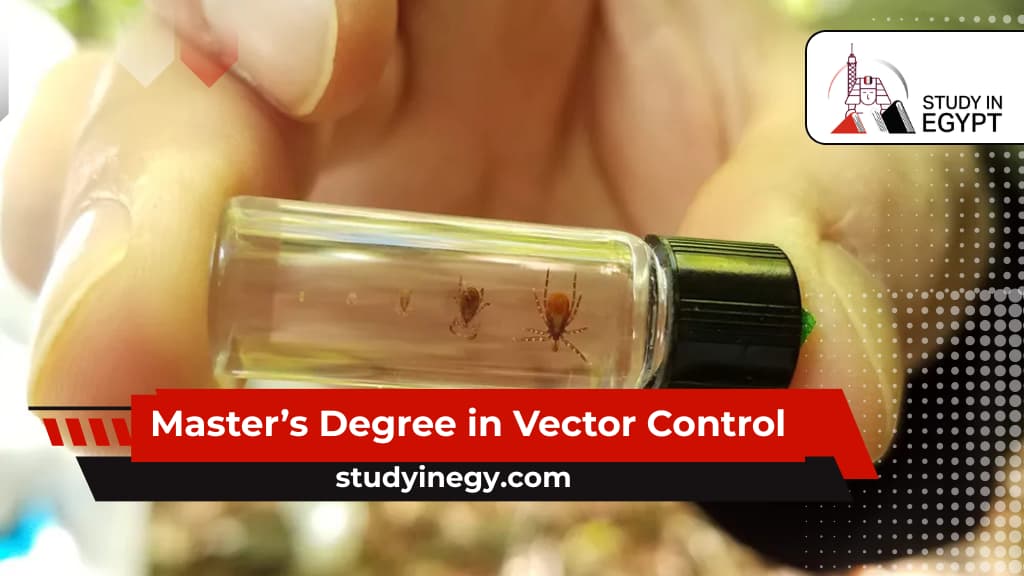
Master’s Degree in Vector Control … With globalization and the rapid increase in international travel, controlling the spread of diseases has become extremely difficult.
A clear example is the COVID-19 pandemic, which was transmitted to humans through an animal disease vector. It devastated global economies and caused millions of deaths worldwide.
Malaria is another example. It has burdened the world for decades and still persists today. Its main vector is the mosquito, which also transmits filariasis and yellow fever.
As disease vectors continue to expand and diversify, the challenge becomes greater. Scientists have identified around 3,000 mosquito species, classified into nearly 35 genera.
With the world becoming more interconnected, controlling infections is increasingly complex. Therefore, countries now give great importance to the science of vector control.
In competitive local, regional, and international job markets, holders of postgraduate degrees have a clear advantage.
For this reason, the Master’s degree in Vector Control has seen growing demand.
Egyptian universities offer this program at the Master’s level. The degree is internationally recognized by global and regional labor markets and major international universities.
The academic level of the program is highly regarded. As a result, graduates enjoy wide acceptance in professional and academic circles worldwide.
This program offers a strong career path and a productive academic future.
It is free from unnecessary complications.
The tuition fees are considered very affordable, especially when compared to similar programs abroad.
In many cases, foreign programs do not offer the same academic value as the Master’s degree in Vector Control awarded in Egypt.
Academic Outcomes of the Master’s in Vector Control
This program combines academic knowledge with practical application.
It provides students with a comprehensive understanding of the field from both scientific and professional perspectives.
Courses are detailed, inclusive, and presented in a simplified and clear manner.
Unlike many other programs, the content is delivered smoothly and systematically.
Students gain broad academic and applied knowledge.
They study the latest developments in vector control science.
The curriculum includes:
-
Classification of disease vectors
-
Anatomy and physiology
-
Control methods
-
Toxicology
-
Medical entomology and microbiology
-
Insect population genetics and evolution
-
Natural insect communities
-
Molecular biology
-
Insect biochemistry
-
Environmental pollution
-
Population dynamics and insect behavior
-
Enzymes
-
Neurophysiology, muscle and endocrine physiology
-
Cell physiology
-
Pesticide chemistry
-
Resistance and modern control strategies
Students face no major academic or practical obstacles during their studies.
In addition, Egyptian universities offer two flexible study strategies.
Students can choose the option that best suits their circumstances.
Both options lead to the same internationally recognized degree.

Study Strategies in the Program
First Strategy: On-Campus Study (Offline)
The student travels to Egypt and studies on campus.
This option combines academic study with a unique cultural and touristic experience.
Egypt offers a friendly society, vibrant social life, and affordable living costs.
Students attend all courses at well-established Egyptian universities.
They interact with experienced professors, doctors, and specialists in vector control.
At the end of the program, they sit for exams and receive their Master’s degree.
Second Strategy: Distance Learning (Online)
This is a modern and carefully designed system.
It is different from traditional online programs that often lack international recognition.
In many cases, online degrees are less valued than on-campus degrees, even when issued by major universities.
To overcome this issue, Egypt introduced a hybrid distance-learning model.
Students study all courses online through interactive platforms.
Lectures are delivered by expert academics from Egyptian universities.
Students do not need to travel or leave their jobs or families during the study period.
They only travel to Egypt to attend final examinations, which last a few days.
Upon completion, they receive the same degree awarded to on-campus students.
This ensures full international and professional recognition.
Program Duration
The Master’s degree in Vector Control lasts two full years.
Target Applicants
The program is open to holders of a Bachelor’s degree in:
-
Engineering
-
Pharmacy
-
Agriculture
-
Science
Tuition Fees for International Students
The cost of studying the Master’s in Vector Control is one of its strongest advantages.
The annual tuition fee is USD 4,500 only.
The one-time registration fee is USD 1,500.
These fees are considered very affordable compared to similar international programs.
This is despite offering the same academic level and a fully accredited degree.