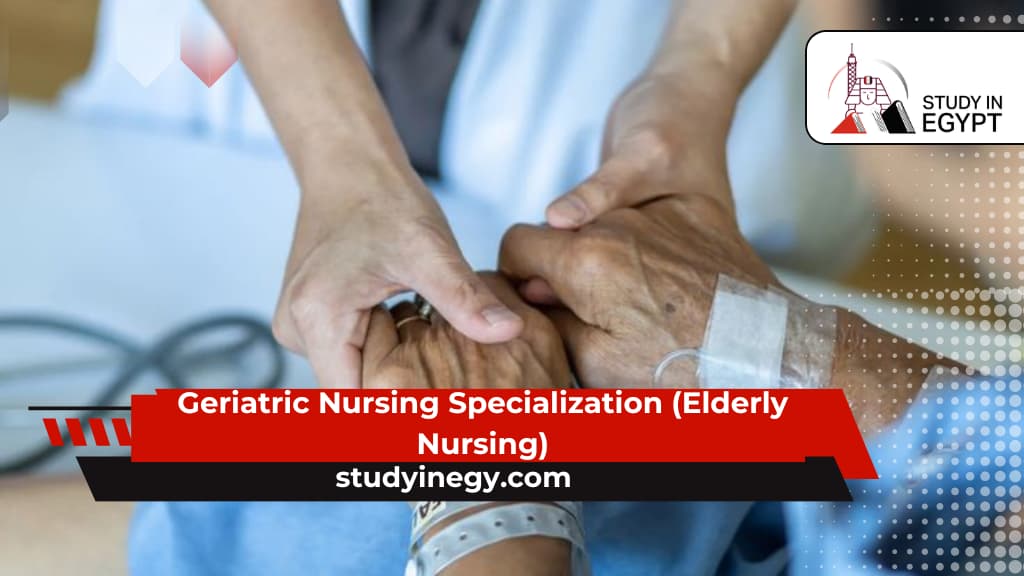
The Geriatric Nursing specialization focuses on providing healthcare and home-based care for the elderly, in addition to supporting their daily needs and overall well-being. It aims to maintain their health, enhance their strength, willpower, and morale, and protect them from illness. Special attention is also given to elderly nutrition. Moreover, older adults are more vulnerable to diseases than other age groups and therefore suffer from health problems more frequently.
Within the healthcare sector, this specialization aims to preserve the care and well-being of older adults by providing comprehensive nursing services. This includes health monitoring, medication management, and dealing with chronic diseases, all with the goal of enhancing public health and improving the quality of life for the elderly.
The geriatric nursing aims to:
-
Assessing the health status of older adults and identifying their medical care needs, as well as organizing and coordinating care services.
-
Managing chronic diseases such as hypertension and diabetes.
-
Developing personalized care plans for each individual and providing psychological support.
-
Preparing graduates to work in nursing homes and elderly healthcare centers.
Importance of Geriatric Nursing
-
Focusing on the mental health of older adults, which is particularly important as they often experience psychological trauma and social and emotional stress. Many elderly individuals find it difficult to adapt to these changes, leading to mental health disorders such as depression and Alzheimer’s disease.
-
Assisting older adults with physical problems associated with aging, such as muscle and nerve weakness, general physical frailty, hearing loss, and visual impairment.
-
Monitoring health and nutritional status and managing associated diseases, while ensuring commitment and enthusiasm among healthcare professionals in planning elderly care services.
-
Integrating older adults into their communities and encouraging participation in social activities to provide social support and enhance self-confidence.
-
Providing comprehensive social and healthcare services for older adults.
-
Improving the overall quality of life and holistic health of the elderly.

Objectives of the Geriatric Nursing Department
-
Studying health problems that may occur during aging.
-
Emphasizing the importance of effective communication when dealing with older adults.
-
Explaining methods used to assess the health status of the elderly.
-
Studying the natural changes associated with aging.
-
Describing community services available for older adults.
-
Explaining the effects of medication administration in elderly patients.
-
Researching theories of aging.
Best Nursing Specializations
The nursing field includes a wide range of scientific, clinical, and applied specialties. Some of the most prominent nursing specializations include:
-
Maternal and Child Health Nursing.
-
Geriatric Nursing.
-
Medical and Surgical Nursing.
-
Psychiatric and Mental Health Nursing.
-
Emergency and Trauma Nursing.
-
Clinical Nursing.
-
Nursing Administration.
-
Surgery and Recovery Nursing.
-
Intensive Care Nursing.
Skills Required for Geriatric Nursing
-
A genuine desire to help others and engage in humanitarian work, with kindness and empathy toward patients.
-
Availability to provide assistance and support at all times.
-
Sufficient energy to deal with different types of patients.
-
Strong memory and good information retention skills.
-
High levels of concentration.
-
Ability to work night shifts.
-
Patience and endurance.
-
Accuracy, integrity, and professionalism.
Career Opportunities and Applications of Geriatric Nursing
Graduates of Geriatric Nursing can work in a wide range of settings, including
-
Implementing independent nursing treatments as part of an approved care plan.
-
Referring patients to specialized institutions based on professional assessment and treatment plans.
-
Referring patients for further treatment through healthcare institutions.
-
Referring patients for additional examinations and diagnostic imaging.
-
Providing initial treatment and referring patients to appropriate medical facilities.
-
Independently managing routine medical procedures.
-
Participating in disease prevention and health promotion activities.
-
Developing patient treatment plans based on diagnostic results.
-
Identifying abnormal cases and emergency situations.
-
Engaging in education and scientific research in the field.
-
Providing counseling to patients and healthcare teams.
-
Assessing and diagnosing patients.
-
Administering pharmacological treatments.
Advantages of Studying Geriatric Nursing
-
High employment capacity, as a single hospital can employ dozens of nurses.
-
Broadening students’ knowledge and gaining diverse experiences in elderly nursing care.
-
Increasing global demand for this specialization in many countries.
-
Suitable career opportunities for both men and women.
-
Enhancing teamwork and cooperation skills.
-
Learning effective communication methods with older adults.
Overall, nursing is a noble and humanitarian profession that offers wide career opportunities. It enables specialists to work in various healthcare institutions and facilities, helping to address many health issues faced by individuals and communities.
Admission Requirements for a Master’s Degree in Geriatric Nursing in Egypt (International Students)
-
International students must hold a valid passport with at least two years of validity.
-
Applicants must hold a Bachelor’s degree in Nursing from a university recognized by the Egyptian Supreme Council of Universities.
-
Required documents must be submitted between May and December.
-
During the study period, students must obtain an international English language proficiency certificate, such as TOEFL.
Duration and Study System of the Master’s Degree in Geriatric Nursing in Egypt
The Master’s degree in Geriatric Nursing in Egypt typically lasts two years, divided into three academic semesters.
The program includes coursework and research based on a credit-hour system totaling 47 credit hours, distributed as follows:
-
36 credit hours for compulsory courses and training.
-
2 credit hours for elective courses.
-
9 credit hours for the Master’s thesis.
Upon completing the required credit hours, the student is awarded a recognized university degree, enabling smooth entry into professional practice.
The study period may be extended to up to four years with student approval if academic work has not been completed, or up to five years upon a request from the thesis supervisor and approval by the faculty council, postgraduate studies committee, and university council.
Cost of Studying a Master’s Degree in Geriatric Nursing in Egypt
One of the main advantages of studying for a Master’s degree in Geriatric Nursing in Egypt is the low tuition cost for international students compared to similar programs offered by global universities at the same academic level.
Students are required to pay a one-time registration fee of USD 1,500 in the first academic year only. The annual tuition fee is USD 5,000.
Why Do Many International Students Choose to Study Geriatric Nursing in Egypt?
Egyptian universities adopt teaching strategies applied by some of the world’s leading universities, combining academic and practical approaches. As a result, students gain extensive and in-depth knowledge in all aspects of geriatric nursing, including
-
Healthcare services management for older adults
-
Geriatric healthcare nursing
-
Medications for the elderly
-
Advanced epidemiology
-
Geriatric medicine
Elective courses may include human development, nursing informatics, and patient counseling.
Students also receive hands-on clinical training in major public hospitals and official nursing homes in Egypt. These institutions serve large numbers of elderly patients with diverse medical conditions, allowing students to gain extensive practical experience under the supervision of highly qualified experts in Egyptian universities and government hospitals.
Accordingly, students enrolled in the Master of Science in Geriatric Nursing in Egypt acquire strong professional experience and extensive knowledge, enabling them to confidently enter regional and international labor markets.