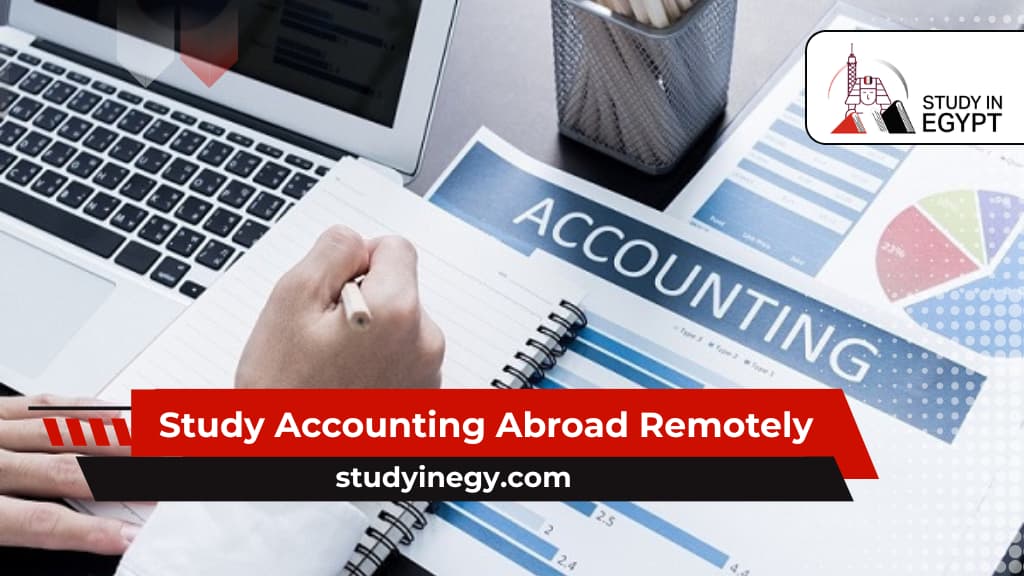
Study Accounting Abroad Remotely … A large number of students are now choosing to study accounting remotely. The truth is, there are several strong reasons that make studying accounting online an excellent choice—especially if you want to balance developing yourself with your daily life responsibilities.
Advantages of Studying Accounting Remotely
1. Flexibility in Time and Location
One of the biggest advantages of distance learning is the freedom to study anytime and from anywhere—whether the university is inside or outside your country. You can study without traveling abroad or being away from your family and home.
This flexibility also lets you go to international universities, so you don’t have to choose local ones with strict requirements, high costs, or little global recognition.
2. Lower Cost Than Traditional Education
Online programs are usually more affordable than on-campus learning because you save on living expenses, transportation, and other costs—especially if studying abroad.
3. Strong Career Demand for Accounting
Accounting itself is a high-demand field. Studying it opens opportunities in:
-
Private companies
-
Banks
-
Tax sectors
-
Auditing firms
-
Business administration, and more.
4. Development of Real Skills
Online programs help you learn:
-
Modern accounting software
-
Remote work skills
-
Time management and discipline
These skills are highly valued today.
Disadvantages of Studying Accounting Remotely
Just as distance learning has advantages, it also has challenges that you need to be aware of:
1. Lack of Direct Interaction
No face-to-face contact with professors or classmates, which may slow understanding or create a sense of isolation.
2. Not All Universities Are Accredited
Some institutions offer degrees with no global recognition, so you must research carefully before choosing a program.
Even reputable international universities often state on the degree that it was completed online—something that reduces its value in the global job market, as many major employers and academic institutions still do not fully accept online degrees.
3. Limited Practical Training
Accounting includes important practical work—software, applications, and teamwork—and online learning sometimes cannot provide the same level of hands-on experience as traditional learning.
How Egyptian Universities Combined the Pros and Cons of Distance Learning
Egyptian universities—especially major public universities like Ain Shams, Cairo, and Alexandria—managed to combine the advantages and disadvantages of remote learning in a unique strategy that makes their programs very different from typical online degrees.
Here is a simple explanation of how they did it:
1. Blending Online Education with Traditional Learning (Hybrid Model)
International students receive the same courses and applied curriculum as on-campus students.
These materials are provided through the university’s official websites and email, so the student never needs to travel to Egypt during the program.
The hybrid approach combines:
-
Theoretical lectures
-
Practical applications using the latest accounting software
2. Same Certificate as On-Campus Students
A rare and valuable feature:
The distance-learning certificate is identical to the on-campus certificate
—without stating that it was completed online.
This gives stronger acceptance in the job market.
3. Full Access to Professors and University Libraries
Even though the program is online, students receive:
-
Digital access to university libraries
-
Communication channels with professors
-
Virtual office hours
Advantage: rich academic resources
Addresses the drawback: reduces isolation and lack of interaction.
4. Practical Training Despite Studying Remotely
Egyptian universities require students in professional programs—such as accounting, business administration, media, and HR—to complete practical training through official platforms.
Advantage: hands-on application
Addresses the drawback: overcomes the lack of practical training commonly found in online education.
5. Well-Designed Online Learning Materials
Universities now provide:
-
Short instructional videos
-
Interactive learning content
-
Strong question banks
-
Easy PDF references
Advantage: easier studying
Addresses the drawback: helps overcome difficulty understanding theoretical subjects.
6. Linking Programs to the Job Market
Some universities connect online programs with:
-
Companies
-
Banks
-
Field training
-
Capstone projects aligned with market needs
Advantage: real career opportunities
Addresses the drawback: improves networking and employability.
Recognition of Egyptian Universities in the Global Market
The global recognition of Egyptian universities was not a single event—it is a long journey that happened across multiple stages and criteria.
International recognition depends on three things:
-
Global recognition of the university itself
-
Accreditation of specific programs (e.g., accounting, engineering, medicine)
-
Global rankings that make the university internationally visible
Here’s the full picture:
1. Global Recognition Began in the Mid-20th Century
Major Egyptian universities such as
-
Cairo University (1908)
-
Ain Shams University (1950)
-
Alexandria University (1938)
became internationally recognized in the 1950s and 1960s due to:
-
British-influenced academic systems
-
Faculty with PhDs from Europe
-
Graduates working internationally
-
Academic exchange agreements
Thus, Egyptian public university degrees have been globally accepted for decades.
2. Entry into Global Rankings (QS & Times)
This step strengthened their international visibility.
-
Cairo University entered the QS ranking around 2006.
-
Ain Shams and Alexandria joined soon after.
-
Since 2010, more Egyptian universities have appeared in global rankings.
3. Establishment of NAQAAE (National Authority for Quality Assurance and Accreditation)
Founded in 2006.
A recognized national accreditation body helped:
-
Standardize quality
-
Increase global credibility
-
Ease international degree equivalency
4. Mutual Recognition Agreements
After 2014, Egypt expanded recognition agreements with:
-
Gulf countries (Saudi Arabia, UAE, Kuwait, Bahrain, Qatar)
-
Some Eastern European countries
-
African countries
Strengthening the global standing of Egyptian universities.
5. International Accreditation of Programs
Some programs have recently earned global accreditations, such as
-
ABET for engineering
-
ACCA and CIMA for accounting pathways
-
AUN-QA for certain university programs
This makes graduates internationally recognized regardless of the country they study in.